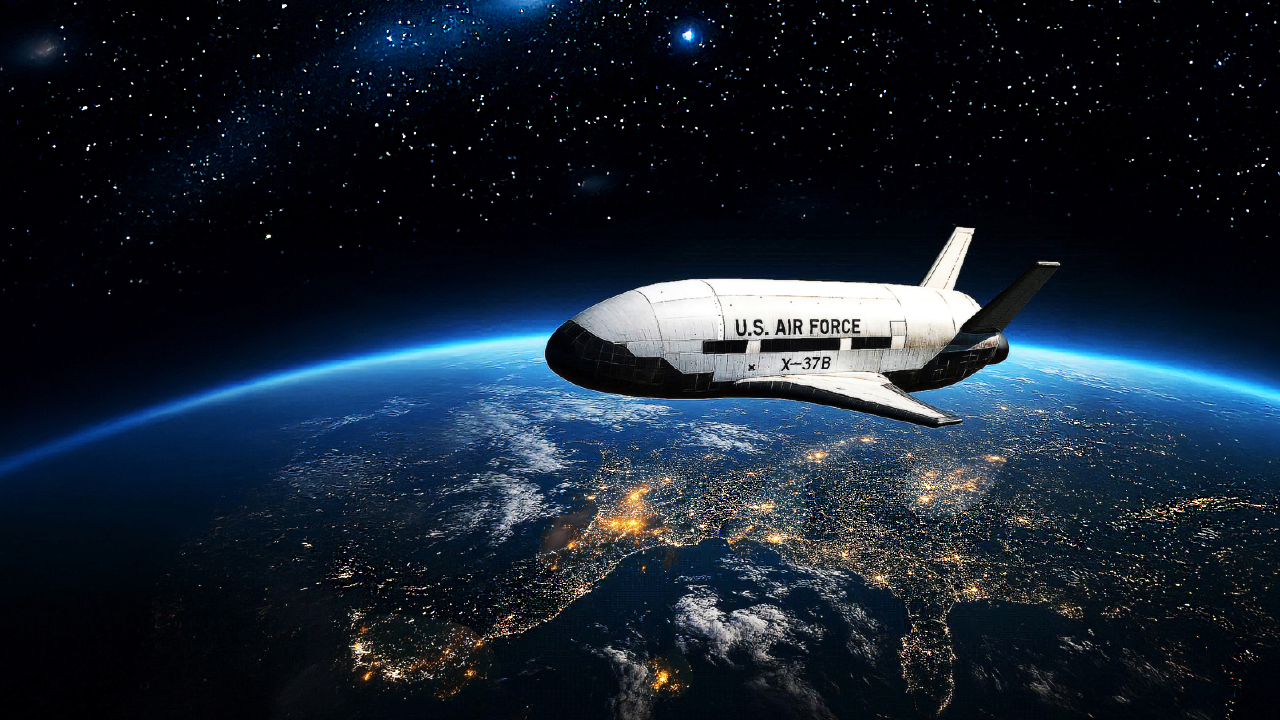
Military missions and space explorations will now rely on quantum technology. Instead of using GPS in space, the American X-37B space plane will test quantum sensors on its eighth mission, scheduled for this Thursday (21). Promising even more accurate navigation, the technology will allow maintaining the spacecraft's location in places with compromised or low availability of satellite signals.
Like this, innovation appears as an important alternative to the use of GPS, which, despite being widely used in different devices, has limitations — especially outside Earth orbit. Furthermore, in conflict situations, signals can be blocked (jamming), counterfeit (spoofing) or even disabled. The objective is to guarantee long-lasting navigation with greater resistance and efficiency.
The spacecraft is the first to test quantum technology in practice, although there are already other scientific experiments in orbit, como o Cold Atom Laboratory, and NASA, by MAIUS-1, from the German space agency. O X-37B, generally, carries out operations in secret, but often serves as a platform for experimenting with new cutting-edge technologies.
How the technology works
The space plane will test quantum inertial navigation sensors, based on atom interferometry. The process consists of cooling atoms to temperatures close to absolute zero and manipulating them with lasers to enter superposition states.. The atoms, when they behave like waves, follow different trajectories that are then brought together, forming interference patterns.
These patterns carry highly detailed information about movements and rotations. Because they are identical and do not show wear like mechanical components, atoms guarantee the system greater sensitivity and lower risk of failure over time.
American military interest
Technological advancement is mainly of interest to the United States Space Force, which seeks to increase operational resilience in situations without access to GPS. In the case of deep space exploration missions — which include future trips to the Moon and Mars — quantum navigation will become indispensable. Like this, Quantum systems have the potential to act not only as support, but also as the main reference for guidance.
Beyond the United States, other nations such as China and the United Kingdom have been accelerating research in the area, testing quantum inertial navigation in planes and submarines. Em 2024, Boeing and AOSense performed the first manned flight using the technology continuously for about four hours without GPS support. In the same year, the United Kingdom announced its first test on a commercial aircraft, reinforcing the international race for safer navigation alternatives.