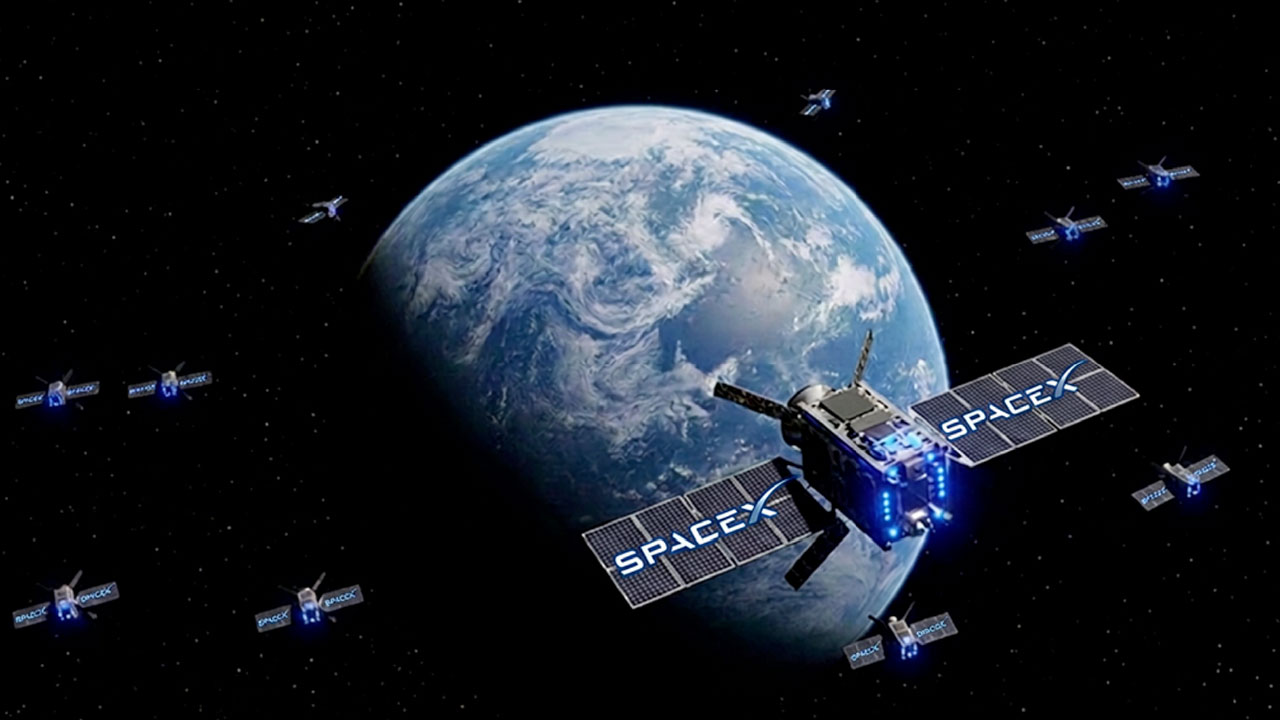
A Starlink, American satellite internet company, plans to expand its coverage by installing new equipment in the Brazilian network. The brand, belonging to Elon Musk's SpaceX, requested Anatel (National Telecommunications Agency) a right to exploit 7,5 thousand units.
If approved, models corresponding to the 2nd generation of satellites produced by Starlink will be implemented, all being explored in low orbit. With the release of Anatel, the company would double its current internet constellation. The new licensed artifacts would elevate Starlink's ability to 4 thousand for 11,9 thousand active satellites.
US approves new facilities
Recently, the company received approval from the Federal Communication Commission (FCC) to install the same number of satellites in the United States. Corresponding to the Ku Band, The forecast is that this new equipment will operate at radio frequencies between 10,7 e 12,7 GHz (for downlink) and between 14 e 14,5 GHz (for uplink).
The Ka Band satellites will operate between 17,8 GHz a 18,6 GHz or between 18,8 GHz e 19,3 GHz (for decide links), like this 27,5 GHz a 28,6 GHz ou 28,8 GHz a 30 GHz (for uplinks). Finally, Band E will be matched by the radio frequencies between 71 GHz e 76 GHz (for downlink) or between 81 GHz e 86 GHz (upload link).
Consultancy will discuss interference
Approval of the degree, although, will depend on public consultancy promoted by Anatel. How new satellites can bring disharmonious coexistence or interference with services from other brands, the agency will listen to companies and leaders in the segment before any approval.
The consultancy has been available on the Anatel participation website since Monday, 22. The deadline is 11:59 pm on 31 July. During this period, the number of licensed artifacts will also be debated, as well as the promotion of processes that guarantee greater sustainability in operations.
Before installation, It is necessary to check whether the volume of equipment will not cause problems for the implementation of new Brazilian networks. In this context, FCC authorization in the United States has been given to only 7,5 one thousand two 29.988 satellites that Starlink wanted to explore.
Starlink is leader in Brazil
At the moment, Starlink is already the largest satellite operator in Brazil. In May this year, the company became a customer leader by registering the brand 162 thousand active contracts and an increase of 38 thousand hits in a single month.
Users of Starlink services pay R$ 250 monthly (with taxes), in addition to the investment of R$ 2 thousand in kit with antenna and router. Despite the numbers, the optical fiber corresponds to 75% of broadband connections in Brazilian territory.
Like this, at the moment, the satellite market still represents only 0,9% of all connections. Amazon's entry into this market is another aggravating factor for Elon Musk's “reign” in this segment.