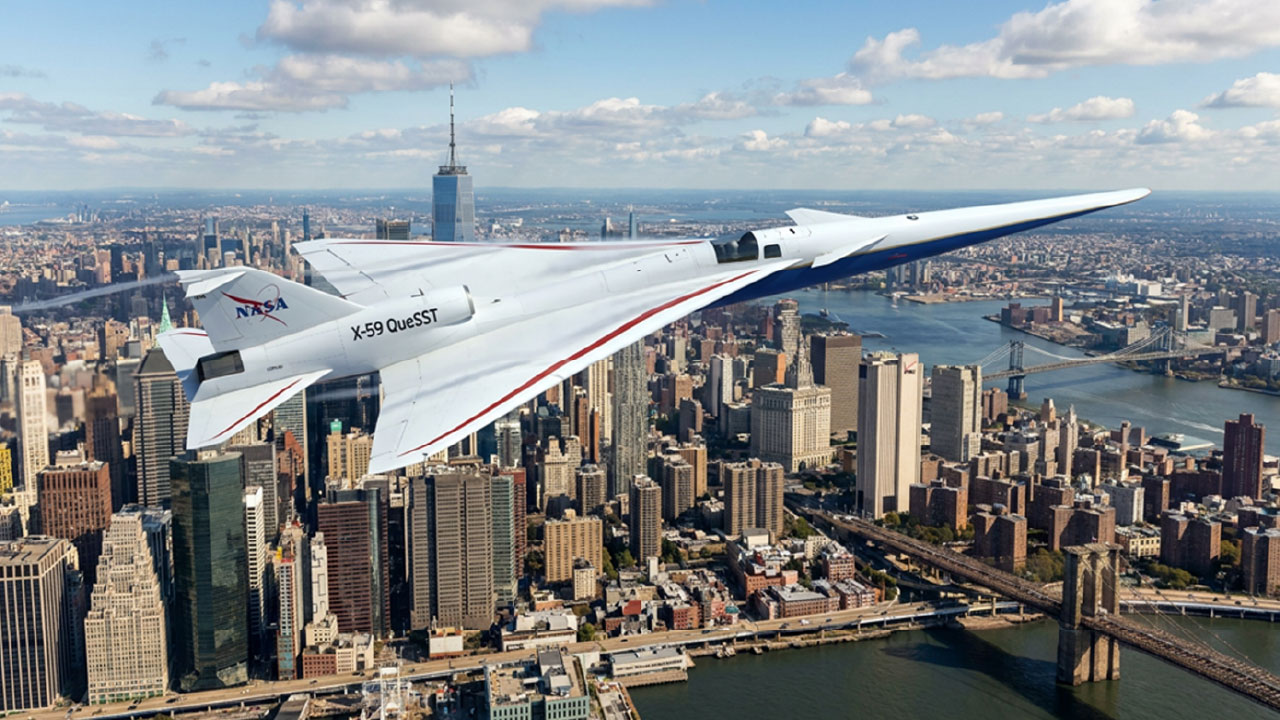
NASA achieves an important breakthrough that could impact the development of commercial aircraft and aviation regulatory standards. Aiming to support changes in supersonic flights over land areas in the United States, the agency completed the first test flights above the speed of sound with the X-59 jet. The experimental model was developed to reduce the sound impact caused by this type of operation, being considered an airplane “silent”.
As reported in the press, the space agency carried out the second test flight in 20 March, near the Armstrong Flight Research Center, em Edwards, in California. The NASA initiative seeks to gather data that supports future changes to aviation standards, proving that the jet produces less noise than that recorded by conventional supersonic aircraft.
Innovative jet technology
The proposal is that the X-59 produces a noise of 75 PldB, a value much lower than around 105 PldB assigned to Concorde, supersonic commercial aircraft that marked aviation between 1976 e 2003. Like this, the novelty would not emit the well-known supersonic boom, but rather a softer noise, reducing the inconvenience caused to people on the ground.
Developed by Lockheed Martin in partnership with NASA, within the Questst mission, the X-59 received a different design, with elongated nose, engine positioned at the top and wings designed to control the formation of shock waves. The distribution of waves along the fuselage allows them to lose intensity before reaching the ground.
“The result is that the human ear will perceive a ‘thump’’ or a ‘breath’, instead of a typical sonic boom”, explained Peter Coen, responsible for the mission. The cabin would be another differentiator of the jet. Due to the long nose, the pilot does not have a conventional front window. The visualization is done by a system with high-resolution cameras via a 4K monitor, transmitting real-time images and flight information in augmented reality.
Next stage of the project
The next stage of the mission involves testing in different North American communities. For about a month in each location, Residents will be invited to report how they perceived the sounds emitted by the X-59. The data collected will be sent to the United States Federal Aviation Administration and the International Civil Aviation Organization to assist in future standards for supersonic flights over land areas..