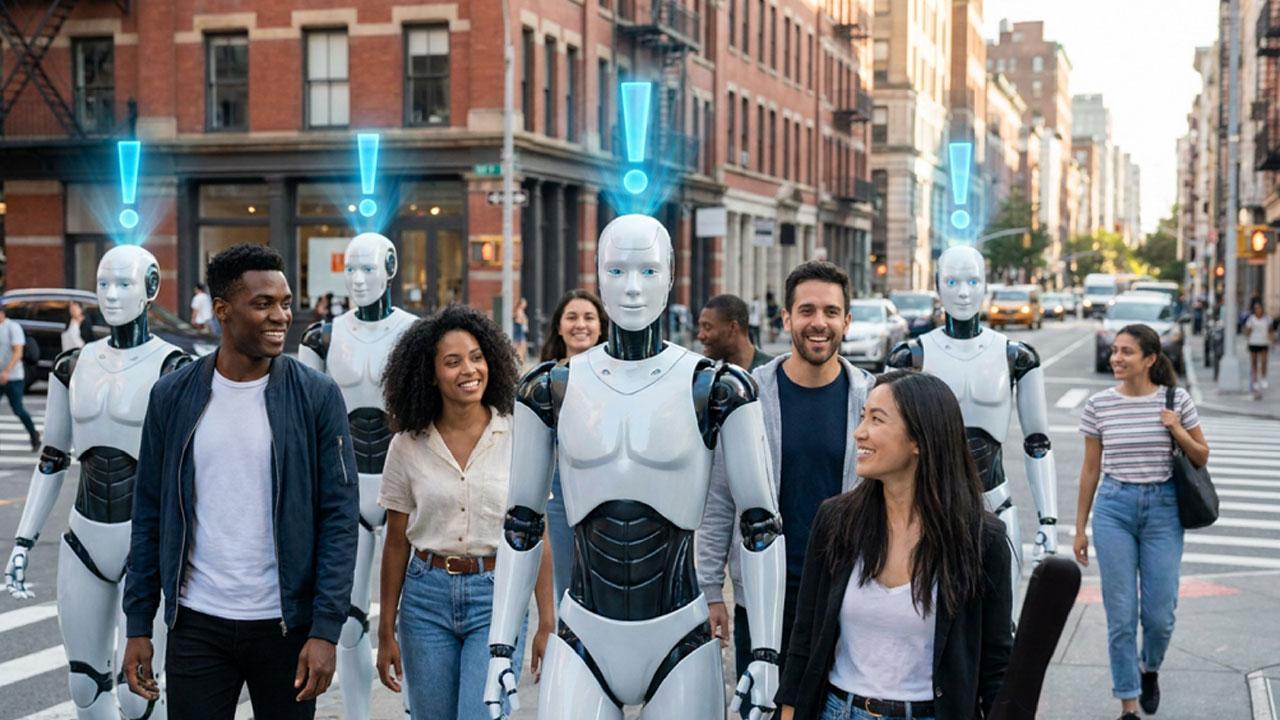
Nvidia introduced Halos for Robotics, a safety system developed for humanoid robots that operate close to humans in work environments. The announcement was made this Monday (22) by CEO Jensen Huang during an artificial intelligence conference (IA). The technology is based on features already tested by the manufacturer in its autonomous vehicles, presented in March 2025.
This launch comes at a time when the robotics industry is looking for standardized ways to prove, with regulatory bodies and corporate clients, that humanoid robots can operate safely alongside humans. The manufacturer claims that the tool is the first security system “full-stack” industry focused on robotics and physical artificial intelligence that operates close to people.
According to Nvidia, Humanoid robots will only gain the confidence to work alongside humans if they are capable of handling split-second decisions. Nvidia already has partners in this new market. Agility Robotics is the first company to adopt Halos for Robotics. Your Digit humanoid robot, designed for industrial tasks in logistics, manufacturing and warehousing, is serving customers like Amazon, GXO, Schaeffler and the Canadian Toyota factory.
How the technology works
Nvidia's innovation proposes a secure architecture by integrating AI computing power, security software, sensor data, specific applications and technical inspection processes. The robot's computational base uses the NVIDIA IGX Thor industrial chip, which already has built-in security features, combined with Halos Core software, responsible for safety-related operational functions.
Furthermore, the manufacturer created the NVIDIA Halos AI Systems Inspection Lab. According to the company, This is the first program in the world accredited by the ANSI National Accreditation Board (ANAB) for functional safety assessment of physical AI systems. The laboratory assists partners in preparing integrations with Halos for external certifications by entities such as TÜV Rheinland, UL Solutions, TÜV SÜD, exida, SGS e CertX.
Tests with Siemens
In April, Nvidia had already carried out tests in partnership with Siemens using the HMND humanoid robot 01, from British manufacturer Humanoid, in a Siemens electronics factory, in Erlangen, in Germany. As a result, the robot operated autonomously for more than eight hours, completing more than 90% assigned tasks and moving around 60 containers per hour.
“Factories of the future require robots capable of perceiving, reason and adapt autonomously alongside human workers”, Deepu Talla said, Vice President of Robotics and Edge AI at Nvidia, about the tests carried out with Siemens.